History

About the Manchuria

Manchuria is a modern name given to a large geographic region in Northeast Asia. Depending on the definition of its extent, Manchuria usually falls entirely within China, or partly in Russia, the Russian part often known as Outer Manchuria in English. Outer Manchuria is the unofficial term for the territory formerly claimed by the Qing Empire and now belonging to Russia, while the Chinese part is known as Inner Manchuria, now usually referred to as Northeast China.

The Manchurian region is the traditional homeland of the Manchu, Xianbei, Korean, Khitan, and Jurchen peoples, who built several states historically. 

Manchu Aisin Gioro Nurhaci founded “Great Jin”. Manchus have their own distinct spoken language and culture. It belongs to the Manchu-Tungusic group in the Altaic language family, as distant relatives to the Turks and Mongols. The written language uses an alphabetic script borrowed from the Mongols. 

In 1636, the Manchu Emperor Aisin Gioro Hongtaiji started the conquest of China. He drove Ming Dynasty forces out of Liaodong and declared a new dynasty, the Qing. He also published a decree to clarify that they were not Jurchen people, that they were Manchus and declared the start of the Great Qing dynasty.

The Manchuria History

Back in 2001, Baltimore was one gritty city when it came to highest ethical standards and practices.

The Manchurian Eight Banners

During the 19th century, Han Chinese nationalists increasingly put the blame for China's continuing defeats by foreign powers on the Manchus, the ruling foreign people. The leader of the Xinhai revolution, Dr. Sun Yat-sen, declared "get rid of the Tartars (Manchus) and restore our Han sovereignty and democracy". message to their future generations. Today the family has more than 100 famous artists throughout the world, and many of their art works are sought after by Chinese collectors.

Aisin Gioro family

Aisin-Gioro is the last name of a Chinese noble family and the imperial clan of Manchu emperors of the Qing dynasty. The House of Aisin-Gioro ruled China from 1644 until the Xinhai Revolution of 1912 which established a republican government in its place. The word aisin means gold in the Manchu language, and "gioro" is the name of a place in present-day Yilan, Heilongjiang Province China. The Aisin-Gioro family created and led the Manchu Eight Banners in conquering the Ming dynasty of China. After moving into the Forbidden City in Beijing, they established a political system that successfully integrated Chinese intellectuals into the administration of the empire. They unified the official language as Mandarin, but by an emperor’s decree, writing must be in both Mandarin and Manchu. They learned Mandarin, studied traditional Han Chinese culture andreligions, and respected Confucianism but do not allow marry to Han Chinese by the law. They used Han Chinese ways to rule over China for the next three hundred years. The Manchu people did not use generation names before moving into China, and prior to the Emperor Shunzi era, children of the royal family were given only Manchu language names. After that point their names included a Han Chinese name and a generation code. The leader of the Yellow Banner was the emperor and the Banners of other colours were led by princes. The family was organized into groups living in "Manchu cities" in Beijing and most provincial capitals. These were separate areas in which to live and had social rankings higher than Han Chinese. After the foundation of the Republic of China, the Aisin-Gioro families started to change their last name to "Jin" in Mandarin, or to use the family generation code as their last name. Also the People's Republic of China banned Aisin-Gioro families from using their traditional last name in family identifiers and had to change their name to a single Mandarin name. As an example, the last emperor Puyi Aisin-Gioro used his generation code for his last name in the family ID, whereas one of his brothers,Puren, used Jin. During the Cultural Revolution, most Aisin-Gioro families did not survive the Red Guards and they became a focal point of the struggle. If someone found out their family history or their last name was hiddenin a Han last name, they were immediately the subject of raids on their homes. Children were tortured in school and insulted on the street and adults were sentto be re-educated in prison or to do forced labor on farms. Today, China is changing, and the Han Chinese now a have greater understanding of the role of the Aisin-Gioro family in Chinese history. If there never had been aQing Dynasty with control over China, there would today be no Tibet, no Inner Mongolia, Xinjiang Province (Uighurs), Taiwan, Shouthwest Yunnan and no Northeast Manchuria inside the territory of China. Since the fall of the Qing dynasty it has been difficult for the Aisin-Gioro family to survive. Many have taking up artistic pursuits and see these as a secret message to their future generations. Today the family has more than 100 famous artists throughout the world, and many of their art works are sought after by Chinese collectors.
The Qing dynasty

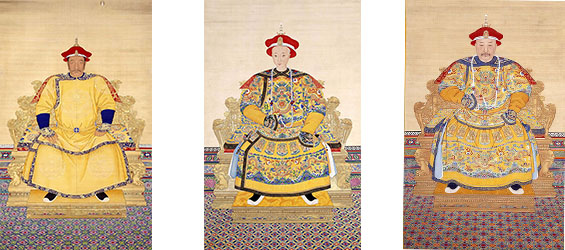
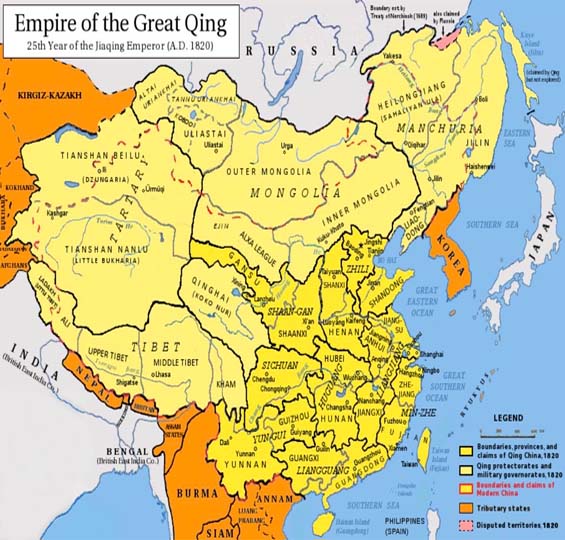
The Qing Dynasty (1644-1911) was the last imperial ruled in China. It was founded by thenon-Chinese Manchu people Aisin Gioro family who originally lived in thenortheast Aisa. The early and highQing emperors Kangxi (1662-1722), Yongzheng (1723-1735) and Qianlong(1736-1795) were patrons of the arts and literature. They also substantiallyexpanded the territory of China by defeating the Oirats or Dzungars (WesternMongols) that had tried to establish an independent khanate in Central Asia,and by conquering the Uyghur states (modern Xinjiang), Tibet and the island ofTaiwan. While the earlyrulers maintained Manchu culture, they governed using Han Confucian styles andinstitutions of bureaucratic government. They retained the imperialexaminations to recruit Hans to work in parallel with Manchus. They alsoadopted the ideals of the tributary system in international relations. Thisblending of Machu and Han culture would become a feature of their success. Qingbecame the most powerful country in the 17th century. The reign of theQianlong Emperor (1735–1796) saw the apogee and initial decline of prosperityand imperial control. The population rose to some 400 million, but taxes andgovernment revenues were fixed at a low rate, virtually guaranteeing aneventual fiscal crisis. Corruption set in, rebels tested government legitimacy,and ruling elites did not change their mindsets in the face of changes in theworld system. At the end of theeighteenth century increasing problems began to haunt Qing China. Monetaryinflation and rampant corruption among the officialdom led to numerous Hanpeasant rebellions. The long period of peace had contributed to a sharpincrease in population growth, and the Hans were now 77.8%, Manchus only 2.9%,while all others were 19.3%. This population distribution meant that therewere many Han people not able to nourish themselves. The big problemexploded in the large Hans purpose: "Overturn Manchu Qing to Recover HansMing" and the Taiping rebellion nearly brought the Qing dynasty to anend. Qing China also wascaught in the so-called "high equilibrium trap" (Mark Elvin) with thecombination of a relatively high agricultural productivity but withouttechnical progress. Very cautious towards the sea and its dangers, the Qing -like their predecessors, the Ming Dynasty - were hesitant in the question ofpromoting international trade. The government only allowed foreigners topurchase tea, silk and chinaware in one single port, Canton Guangzhou. (Guanzhou city Guangdong province), but refused to open more ports to Britishand other overseas merchants. The question of opium smuggling was the sparkthat ignited the first of a series of wars in which Western powers"opened" China for trade and missionaries. Peaceful times alsoled in to friction in the Aisin Gioro families. Those that had beentightly knit families now fought with one another. Assimilation of Han cultureweakened the Manchus military culture and the moral resolve of the Aisin Gioro's Manchu society became increasingly focused on individual self-interest. An ambitious HundredDays' Reform of 1898 was turned back by Empress Dowager Cixi. Cixi's non -sense passing of her throne to a toddler forced the latter Qing dynasty todepend totally on Han chancellors led by Shikai Yuan. The 1911Revolution "get rid of the Tartars (Manchus) and restore Han China"initiated the disintegration of the empire and the founding of a Republic(1912-1949) without any clear political leader but Sun Yat-sen. The last emperorabdicated on February 12, 1912. Shiksa Yuan was the President of theRepublic of China succeeding Sun Yat - sen. (1912-1916) and the last Emperor ofthe Empire of China 1916.

Emperor Nurehaci

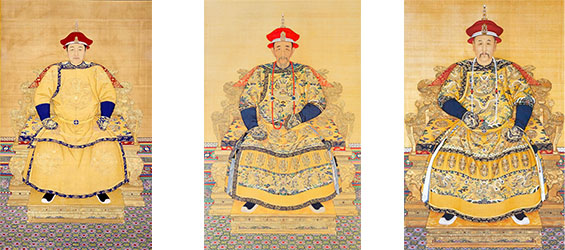
Manchu Tianming Khan (King) Emperor Aisin Gioro Nurehaci (1559—1626) The Emperor Nurhaci was Kundulun Khan of the Mongols, and Khan (king) of the Jin in Manchuria. He was a Jurchen chieftain and the unifier of Jurchen tribes and founder of the latter Jin Dynasty in Manchuria. (1616-1626). He reorganized and united various Jurchen tribes, consolidated the Eight Banners military system, and eventually launched attacks on Ming dynasty China and Joseon Korea. His conquest of Ming China's northeast laid the groundwork for the conquest of the rest of China by his descendants, who founded the Qing in 1644. He also generally credited with ordering the creation of a written script for the Manchu language. Nurhaci led many successful engagements against the Ming Chinese, the Koreans, the Mongols, and other Jurchen clans, greatly enlarging the territory under his control. By May 1621, Nurhaci had conquered the cities of Liaoyang and Shenyang of Manchuira . In April 1625, he designated Shenyang the new capital city, which would hold that status until the Manchu Qing conquest of Ming of China. Nurhaci died September 1626 and his son Hong Taiji become Khan of Later Jin dynasty.

Aisin Gioro Nurehaci

Manchu Tianming Khan (King) Emperor Aisin Gioro Nurehaci (1559—1626) The Emperor Nurehaci was Kundulun Khan of the Mongols, and Khan (king) of the Manchuria. He was a Jurchen chieftain and the unifier of Jurchen tribes and founder of the Jin Dynasty in Manchuria. (1616-1626). He reorganized and united various Jurchen tribes, consolidated the Eight Banners military system, and eventually launched attacks on Ming dynasty China and Joseon Korea. His conquest of Ming China's northeast laid the groundwork for the conquest of the rest of China by his descendants, who founded the Qing in 1644. He also generally credited with ordering the creation of a written script for the Manchu language. Nurhaci led many successful engagements against the Ming Chinese, the Koreans, the Mongols, and Jurchen clans, greatly enlarging the territory under his control. By May 1621, Nurhaci had conquered the cities of Liaoyang and Shenyang of Manchuira. In April 1625, he designated Shenyang the new capital city, which would hold that status until the Manchu Qing conquest of Ming of China. Nurhaci died September 1626 and his son Hong Taiji become Khan (King) of Manchuira.

Emperor Shunzhi

Emperor Shunzhi - Aisin Gioro Fulin (1638 –1661) The Shunzhi Emperor was the third emperor of the Manchu Qing dynasty and the first Qing emperor to rule over China. He ruled from 1644 to 1661. A committee of Manchu princes chose him to succeed his father, the emperor Hong Taiji when he was five years old. The princes also appointed two co-regents: Dorgon (1612–1650), the 14th son of the Qing dynasty's founder Emperor Nurhaci, and Jirgalang (1599-1655) one of Nurhaci's nephews, both of whom were members of the Qing imperial clan. The emperor Shunzhi was the name of this ruler's reign in Chinese. This title had equivalents in Manchu and Mongolian because the Qing imperial family was Manchu, and ruled over many Mongol tribes that helped the Qing to conquer China. From 1643 to 1650, political power lay mostly in the hands of Dorgon. Under his leadership, the Manchu Empire conquered most of the territory of the fallen Ming dynasty (1368–1644) of China and chased Ming loyalist regimes deep into the southwestern provinces, establishing the basis of Manchu rule over China. This was despite highly unpopular policies such as the "hair cutting command" of 1645, which forced Qing subjects to shave their forehead, and braid their remaining hair into a queue resembling that of the Manchus. After Dorgon's death on the last day of 1650, the young Shunzhi Emperor started to rule personally. He tried, with mixed success, to fight corruption and to reduce the political influence of the Manchu nobility. The Shunzhi Emperor died at the age of 22 of smallpox, He was succeeded by his third son the emperor Kangxi.

Aisin Gioro Hongtaiji

Manchu Tianchong Khan (King),Mongol Da Khan( King), Congde -Aisin Gioro Hongtaiji (1592—1643) The emperor Hong Taiji was a Manchuria TianchongKhan (King), Mongol Da Khan( King), and an Emperor of the Manchu Qing dynasty . He was responsible for consolidating the empire that his father, later Jin dynasty khan Nurhaci, had founded and laid the groundwork for the conquest of the Ming dynasty, although he died before this was accomplished. He was also expounded of his people were from Manchuria and named Manchus in 1635. and Changed dynasty from Jin to Qing in 1636. Also Because his father, Nurhaci Khan did not assume an imperial title while alive, Hong Taiji was considered to be the first emperor of Manchu Qing dynasty, Then his father Nurhaci Khan was posthumously awarded the imperial title, Hong Taiji is usually called the second emperor of the Manchu Qing dynasty. Hong Taiji died on 21 September 1643 just as the Qing were preparing to attack Shanhai Pass, the last Ming dynasty fortification guarding access to the north China plains. Because he died without having named an heir, the Qing state now faced a succession crisis. The Deliberative Council of Princes and Ministers debated on whether to grant the throne to Hong Taiji's half-brother Dorgon – a proven military leader – or to Hong Taiji's eldest son Hooge. As a compromise, Hong Taiji's ninth son Fulinwas chosen, while Dorgon, alongside Nurhaci Khan nephew, Jirgalang, was given the title of "prince regent". Fulin was officially crowned emperor of the Manchu Qing on 8 October 1643 and it was decided that he would reign under the era name "Shunzhi." A few months later, Manchu Qing armies led by Dorgon seized Beijing, and the five years old Shunzhi Became the first Qing dynasty emperor to rule from that new capital.

Aisin Gioro Xuanye

Emperor Kangxi - Aisin Gioro Xuanye (1654-1722) The Kangxi Emperor was the fourth emperor of Manchu and the first to be born on Chinese soil and the second Qing emperor to rule over China proper. He ruled from 1661 to 1722. Kangxi's reign of 61 years makes him the longest-reigning emperor in Qing history (although his grandson, the Qianlong Emperor, had the longest period of de facto power) and one of the longest-reigning rulers in the world. However, since he ascended the throne at the age of seven, actual power was held for six years by four regents and his grandmother, the Grand Empress Dowager Xiaozhuang. Kangxi is considered one of Qing's greatest emperors. He suppressed the Revolt of the Three Feudatories, forced the Kingdom of Tungning in Taiwan to submit to Qing rule, blocked Tsarist Russia on the Amur River and expanded the empire in the northwest. He also accomplished such literary feats as the compilation of the Kangxi Dictionary. Kangxi's reign brought about long-term stability and relative wealth after years of war and chaos. He initiated the period known as the "Prosperous Era of Kangxi and Qianlong" or "High Qing” which lasted for generations after his own lifetime. By the end of his reign, the Qing Empire controlled all of China proper, Taiwan, Manchuria, part of the Russian Far East(Outer Manchuria), both Inner and Outer Mongolia, and Tibet proper. Kangxi's reign also saw a prolonged struggle between various princes over who should inherit the throne – the Nine Lords' War. In the evening of 20 December 1722 before his death, he was succeeded by his 4th son, the Yongzhen Emperor.

Aisin Gioro Injen

Emperor Yongzheng - Aisin Gioro InJen (1678 - 1735) The Yongzheng Emperor was the fifth emperor of the Manchu -led Qing Dynasty of China, and the third Qing emperor to rule over China proper. He was the "the Nine Lords' War" winner during the Kangxi reigned. He reigned from 1722 to 1735. he was a very hard-working ruler, Yongzheng's main goal was to create an effective government at minimal expense. Like his father, the Kangxi Emperor, Yongzheng used military force to preserve the dynasty's position. His reign was known for being despotic, efficient, and vigorous. Although Yongzheng's reign was much shorter than that of both his father (the Kangxi Emperor) and his son (the Qianlong Emperoro), Yongzheng continued an era of peace and prosperity. He cracked down on corruption and reformed the financial administration. His reign saw the formulation of the Grand Council, an institution which had an enormous impact on the future of the Qing dynasty. The Yongzheng Emperor ruled the Qing Empire for 13 years before dying suddenly in 1735 at the age of 56. He devised a system for his successors to choose their heirs in secret. He wrote his chosen successor's name on two scrolls, placed one scroll in a sealed box and had the box stored behind the stele in the Qianqing Palace of Forbidden City. He kept the other copy with him or hid it. After his death, the officials would compare the scroll in the box with the copy he had kept. If they were deemed identical, the person whose name was on the paper would be the new emperor. he used this way successor to his fourth son Qinglong Emperor.

Aisin Gioro PuRu (Pu Xinyu) 溥心畬

Aisin Gioro PuRu (Pu Xinyu) 愛新覺羅 溥儒 Puru was born in 1896 also known as Pu Xinyu with Xinyu as his courtesy name, was a traditional Chinese painter and calligrapher. He was grandson of Yixin (Prince Gong), a cousin to last emperor Puyi. Puru was a student at the University of Berlin. After he returned from Europe, he retreated into the Western Mountains, where he spent many years in Jietai Monastery to concentrate on his studies. After the fall of the Qing dynasty in 1911, he changed his family name to "Pu". In 1947, Puru was appointed by Chiang Kai-shek as a Manchu representative at the Constitutional National Assembly. He was strongly against Puyi's cooperation with the Empire of Japan, foresaw the unrest in China and fled to Taiwan in the same year as Chang Kai-shek did. In Taiwan, Puru made a living by selling paintings and calligraphy works during the first months of his arrival in Taipei. He lived in a Japanese-style house on Linyi Street in Taipei that the government provided for him. He was appointed in October 1949 as a professor of fine arts at the National Taiwan Normal University. In 1959, he held a two-week-long art exhibition at the National Museum of History with 318 works on display. Puru died in 1963, He was reputed to be one of the most talented famous artist In China.

Nurhaci
Jiaqing Emperor
Hong Taiji
Daoguang Emperor
Shunzhi Emperor
Tongzhi Emperor
Kangxi Emperor
Guangxu Emperor
Yongzheng Emperor
Puyi
Qianlong Emperor
Qing dynasty

Any Queries?

Get in touch with us

We are always here to help with any questions, sales inquiries, sponsorships, etc.

Powered By PortoCloud Media © 2024. All Rights Reserved
Privacy Policy / Terms of Use